
The Puppet Who Dreams of Strings
Nietzsche, Schopenhauer, and the Architecture of the Self

Over the years, I’ve written some essays on Nietzschean themes. Since there is a lot of you who are new here I thought it would be good to go back and revisit some of those older topics.
This particular essay is required reading for anyone who is a little lost whenever Nietzsche is being discussed.
—Or if you are interested in depth-psychology.
The ideas presented here had an impact on depth-psychology that cannot be over-stated, particularly in the work of Freud and Jung.
Nietzsche called Schopenhauer his “mentor.” What is not well known is the extend of the influence Schopenhauer had on Nietzsche. So much so that it becomes necessary to compare both philosophers side by side.
Even when he (Nietzsche) is criticizing Schopenhauer, he is doing so within a Schopenhauerian framework.
In Schopenhauer’s view our innermost essence is not a theoretical soul, but instead an organic willing and drive-like body. This embodied will comprises our true self, whereas consciousness has only a minor role in our existence.
In Schopenhauer’s view we come to know ourselves exclusively as will, or as he calls it, a “subject of willing”—we are not aware of ourselves as souls at all, but as an embodied will.1
Schopenhauer says the proposition ‘I know’ is not an immediate certainty whereas “I will” is a genuine expression of substantial, and empirical self-knowledge. Our will is known to us by our experience of the will through time and space.
What Schopenhauer refers to as ‘will’ is not an intellectual or mental state but a concept for all feeling and organic functions—even non-conscious acts like digestion.
“Everyone who observes his own self-consciousness will soon become aware that it's object is at all times his own willing. By this, however, we must understand not merely the definite acts of will that lead at once to deeds, and the explicit decisions together with the actions resulting from them. On the contrary, whoever is capable of grasping in any way that which is essential [...] will have no hesitation in reckoning as manifestations of willing all desiring, striving, wishing, longing, yearning, hoping, loving, rejoicing, exulting and the like, as well as the feelings of unwillingness or repugnance, detesting, fleeing, fearing, being angry, hating, mourning, suffering, in short, all affects and passions.” Arthur Schopenhauer, The World As Will And Representation
Schopenhauer is insisting that willing is a holistic term for our experiences, pains, pleasure, emotions—in sum the entire inner psychic life and all organic functions.
In other words the will is the basis for our embodied self-consciousness.
In this view self-consciousness—by virtue of the will—provides us with privileged access to ourselves through our first person experience of ourselves as bodies. Self-consciousness is thus linked to our bodily nature.
The body is known to us from two radically different perspectives. From one perspective the body is a representation of an object in time and space subject to causal laws. In the other view we have inner experiences of our body.
This inner awareness is an awareness of our will.
The consequence of this view is that any distinction between an awareness of the will and the awareness of the body is nothing more than an abstraction. Awareness of the body is an awareness of the will and vice versa.
“Finally, the knowledge I have of my will, although an immediate knowledge, cannot be separated from that of my body. [...] the body is the condition of knowledge of my will. Accordingly, I cannot really imagine this will without my body.” The World As Will And Representation, 18
What we—from an external perspective—call body is will when viewed inwardly.
The distinction between the subject, ego and the deeper self is a distinction that Nietzsche borrows from Schopenhauer. This is clear from a section of “Thus Spoke Zarathustra” entitled “The Despisers of the Body”. The despisers of the body are those who view the soul as our true essence and consider it superior to the body. To these Zarathustra says:
“the awakened and knowing say: body am I entirely, and nothing else; and soul is only a word for something about the body.” Friedrich Nietzsche, Thus Spoke Zarathustra, On The Despisers of the Body
The main idea Nietzsche tried to reject in this quotation is the same idea Schopenhauer rejected. Which is that our true self lies in the realm of consciousness and reason—and that introspection provides us with true knowledge about ourselves. Schopenhauer’s assertion that we have privileged access to our will is actually a remnant of this same idea and Nietzsche rejects such foundationalism.
The will isn’t immediately known to us either.
“There are still harmless self-observers who believe that there are “immediate certainties”; for example, “I think,” or as the superstition of Schopenhauer put it, “I will”; as though knowledge here got ahold of its object purely and nakedly as “the thing-in-itself”, without any falsification on the part of either the subject or the object. But that “immediate certainty,” as well as “absolute knowledge” and the “thing-in-itself,” involve a contradictio in abjecto [contradiction in terms].” Friedrich Nietzsche, Beyond Good and Evil, 16
Despite Nietzsche’s critique of Schopenhauer’s foundationalism here, he still thought that the body enjoyed a privileged status simply because it is more easily grasped and understood as opposed to the ego or self.
According to Nietzsche, the Schopenhauerian will is at bottom a whole host of instincts, drives and affects which share the same reality as the body.
A common point of confusion for Nietzsche readers is his use of the terms “drives” and “souls”. What makes this more confusing is Nietzsche’s rejection of the “soul-hypothesis”.
Adding to the confusion, he writes Beyond Good and Evil stating that the body is a “society constructed of drives and affects”.
It may seem like a contradiction that Nietzsche uses the term soul to describe the bodies plurality while he earlier calls it a fiction. There are a few reasons for this. But first Nietzsche says that just because we don’t believe in the soul doesn’t mean we should discard the term. As he writes in Beyond Good and Evil:
“Between ourselves, it is not at all necessary to get rid of “the soul” [...] and thus to renounce one of the most ancient and venerable hypotheses. [...] But the way is open for new versions and refinements of the soul-hypothesis; and such conceptions as “mortal soul,” and “soul as subjective multiplicity,” and “soul as social structure of drives and affects,” want henceforth to have citizens’ rights in science.” Friedrich Nietzsche, Beyond Good and Evil, 12
Nietzsche is attempting to transform the way the soul is traditionally understood. The ‘souls’ he refers to are the drives which make up our body and self and he describes these in various ways such as “under-wills,” “under-souls,” mortal souls or “wills to power”. The term ‘soul’ highlights the feeling, willing, perceptive and intelligent nature of the drives. They also prevent Nietzsche’s description of the body and mind from being understood in purely mechanistic terms. Drives aren’t machines or lifeless systems.
Whereas Schopenhauer views the will as the unified basis of the body and mind, Nietzsche conceptualized the will as a multiplicity of “drives” or “souls”. The drives have the same reality as our organic body that they compose.2
Instead of Schopenhauer’s unified will, Nietzsche conceptualized the body as a multiplicity of living beings. However Nietzsche is very insistent that these souls not be thought of as atomistic.
“And for us, even those smallest living beings which constitute our body (more correctly: for who's interaction the thing we call ‘body’ is the best simile-) are not soul-atoms, but rather something growing, struggling, reproducing and dying off again: so that their number alters unsteadily, and our living, like all living, is at once an incessant dying.” Friedrich Nietzsche, Nachlas
Nietzsche describes the relations between these “beings,” “wills to power” or “under-souls” with political metaphors by calling them a “society”. The political nature of the drives lies in the power relations among a multiplicity of wills to power— which implies competition, cooperation and conflict but also organization, coordination and hierarchy depending on the arrangements ensuing from the resulting conflict and reconciliation.
"By following the thread of the body we recognize the human being as a multiplicity of living beings which—partly fighting one another, partly hierarchized and subordinated to one another—by affirming their individual existence involuntarily also affirm the whole.” Friedrich Nietzsche, Nachlas
Nietzsche’s holistic term for the nature of these conflicting drives, the “will to power”, was explicitly intended to be opposed to Schopenhauer’s will. Instead of a “will to power” Schopenhauer proposes a “will to life”.
“Will” and “will to life” are synonymous with Schopenhauer. Nietzsche thinks that Schopenhauer's “will to life” doesn’t adequately describe the basic nature of any living being, because life does “everything it can not to preserve itself but to become something more.” Life seeks appropriation, expansion, or domination—in short—to increase its power.3
“Psychologists should think twice before positioning the drive for self-preservation as the cardinal drive of an organic being. Above all, a living thing wants to discharge its strength–life itself is will to power-: self preservation is only one of the indirect and most infrequent consequences of this.” Friedrich Nietzsche, Beyond Good and Evil, 13
The will to power is a difficult concept to grasp, partly because Nietzsche never systematically explored it. Will to Power describes the basic drive of all organisms which pursues growth and mastery. Will to Power is also meant as a holistic concept that emphasizes the power relations among the drives within the ‘social structure’ that is the body.
Instead of a unified will in the Schopenhauerian sense, Nietzsche’s “will to power” is a designator for the inner forces of the human being—an endless flux of creation, destruction, evolution, change and transformation—produced by an eternal struggle amongst opposing forces which fight for their own growth, enhancement and power.
Thus in Nietzsche’s eyes, the human being is a consequence of the relations of command and submission within, the reflex of the hierarchies that are established, destroyed, reestablished and transformed within the self.
A will to power does not simply desire more—it seeks more of the kind of activity it recognizes as its own. It expands by appropriating and transforming what lies outside itself, integrating it into its own pattern of expression. In this way, the will to power is a will to self-overcoming: it grows by constantly reshaping itself, destroying its present form in order to become something more.
“Life itself confided this secret to me: “Behold,” it said, “I am that which must always overcome itself.” Indeed you call it a will to procreate or a drive to an end, to something higher, farther, more manifold: but this is one, and one secret.” Friedrich Nietzsche, Thus Spoke Zarathustra, II, On Self-Overcoming
The Architecture of the Will
If, as Nietzsche insists, we are at bottom a multiplicity of living forces—“wills to power”—or, for Schopenhauer, a single underlying will, then what role does consciousness play in this framework?
Conceiving the human being as a body—and the body as a field of competing drives and power-relations—demands a radical revaluation of consciousness. For both Nietzsche and Schopenhauer, consciousness is only a narrow thread within the broader fabric of bodily existence.
By arguing that all organic functions belong to the will, even involuntary ones, implies that the activity of the will does not require conscious participation.
Both Nietzsche’s and Schopenhauer’s account of consciousness involves a pretty radical devaluation of the latter. For both thinkers, the will should be viewed in its innermost essence as unconscious.
Schopenhauer distinguished the unconscious drive-like and irrational nature of the will from that of the rational intellect which has the opposite set of features. The unconscious irrational will is primary and constitutes our “true self’ and is opposed to consciousness. Schopenhauer describes the relation between consciousness and the will in the context of the brain and organism. The organism is the whole of our organic life while the brain is just one of its organs, an appendix that regulates its relations with the outer world. Schopenhauer even calls consciousness a parasite on the organism.
It's a secondary and accidental part of our being.
Our ego-consciousness is only a transitory state of the will as the metaphysical basis of the whole organism. The intellect serves the general conservation and reproduction of the whole organism, as mediator between the world and the will. As such the intellect is only a tool of the will. Nietzsche followed Schopenhauer in considering the ego as a tool of the body.
Intellect is not sovereign but servile.
“Ultimately, we understand the conscious ego itself only as a tool in the service of a higher, comprehensive intellect; and then we are able to ask whether all conscious willing, all conscious purposes, all evaluations are not perhaps only means through which something essentially different from what appears in consciousness is to be achieved.” Friedrich Nietzsche, Nachlas 148
For Nietzsche and Schopenhauer consciousness is only a surface or mirror of the realm of the complex, unknown and mostly unknowable inner processes of our being. This makes it an accidental almost parasite-like feature of our existence, something we could do entirely without.
“For we could think, feel, will, and remember, and we could also “act’ in every sense of that word, and yet none of all this would have to “enter our consciousness” (as one says metaphorically). The whole of life would be possible without, as it were, seeing itself in a mirror. Even now, for that matter, by far the greatest portion of our life actually takes place without this mirror effect; and this is true even of our thinking, feeling, and willing life.” Friedrich Nietzsche, The Gay Science, 354
Not only is life possible without consciousness but most of it happens without the interference of consciousness. What is more, the thoughts which we do have access to are a final product of unconscious processes that only emerge into consciousness if there is little or no resistance to them.
Sigmund Freud who was indebted to both Nietzsche and Schopenhauer wrote in his book “Notes on the Unconscious” published in 1912:
“Unconsciousness is a regular and inevitable phase in the processes constituting our psychical activity; every psychical act begins as an unconscious one, and it may either remain so or go on developing into consciousness, as it meets with resistance or not.” Sigmund Freud, Notes on the Unconscious (1912).
Nietzsche was much more radical than Schopenhauer.
Whereas Schopenhauer thought we had knowledge of ourselves as will. In Nietzsche’s view, conscious thoughts are a by-product of the activity of our inner drives and affects, “a more or less fantastic commentary on an unknown, perhaps unknowable, but felt text”4, as he wrote in Dawn.
As such, the image we have of ourselves is vague, incomplete and illusory. We are unaware of the forces continually at play below our consciousness which decisively shape our character and destiny.
If consciousness is superfluous and unnecessary then why do we have it?
—This answer depends on which philosopher you ask.
In Schopenhauer's view consciousness emerged as a medium of our inner motives. In order to live we need to have a guide for our representations of the outer-world instead of just relying on sensory stimuli. Consciousness arose out of the organisms' need for survival in a competitive world.
Nietzsche also viewed consciousness as fulfilling certain organic needs. However his account is different from Schopenhauer’s. It was our need to communicate that created consciousness—consciousness is a product of our herd-like nature.
“Consciousness is really a net of communications between human beings: it is only as such that it had to develop; a solitary human being who lived like a beast of prey would not have needed it.” Friedrich Nietzsche, The Gay Science, 354
Both Nietzsche and Schopenhauer see consciousness as a mediator between the inner drives and the outside world. For Schopenhauer the emphasis is on the individual—whereas for Nietzsche, it’s the group.
Schopenhauer’s account of the will and intellect is marked by a tension. On the one hand, the intellect is an expression of the will—it is the will coming to know itself as object. On the other hand, he insists on a qualitative distinction between them: the will is the thing-in-itself,5 while the intellect belongs to the realm of representation. Consciousness, in this view, is self-referential—it reflects the will back to itself by appearing to it as an object, like seeing itself in a mirror.
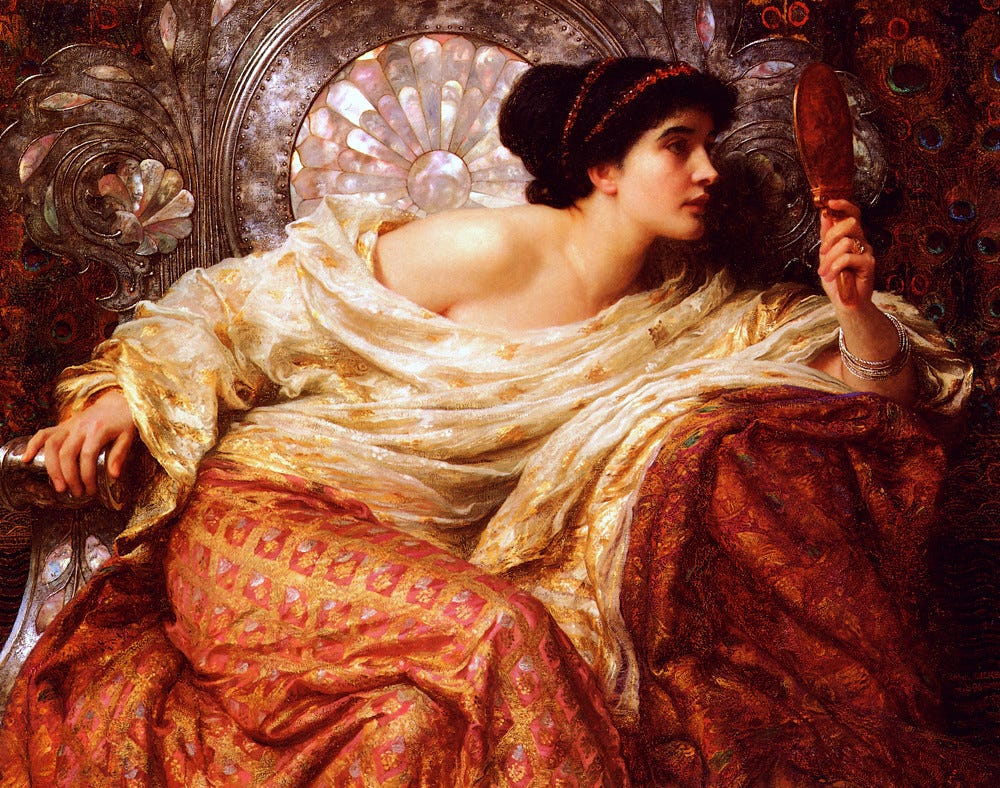
“The world now shows its second side; hitherto mere will, it is now at the same time representation, object of the knowing subject.” Arthur Schopenhauer, World As Will and Representation, Ch. 19, 208
Intellect becomes, for Schopenhauer, “the cold indifferent spectator, the mere guide and counselor of the will.”
The intellect becomes separate from the will, whereas the will is totally blind and devoid of intellect. It seems that Schopenhauer is suggesting that the intellect becomes separate from the will when it sees itself in the mirror as a mask.
Nietzsche criticized Schopenhauer for his dualism, arguing that it did not follow from his claim that the will is the ground of our being—it’s an artificial separation.
Nietzsche rejects this dualism by criticizing its two main assumptions: that the will is blind; that the intellect is unaffected by the will.
In Nietzsche’s view all life exists on a continuum in all its possible manifestations—meaning nothing is truly separate from anything else.
Differences are not in essence but in degree.
Nietzsche's description of the intellect as a “small reason” and the body as a “great reason” should be understood as a criticism of Schopenhauer on Schopenhauer’s own terms.
“The body is a great reason, a plurality with one sense, a war and a peace, a herd and a shepherd. An instrument of your body is also your little reason, my brother, which you call “spirit”—a little instrument and toy of your great reason.” Friedrich Nietzsche, Thus Spoke Zarathustra, On the Despisers of the Body
The intellect is really, at bottom, a multiplicity of drives that form a unity and—when taken as a whole—are already rational. And since it (the intellect) belongs to this greater unity, it cannot be separated, let alone opposed to it, because it shares in the body's instinctive drive-like nature.
Nietzsche attributes intelligence to the body as a consequence of its processes of self-organization, direction, purpose and its behaviors, decisions and actions. The body is intelligent to the degree that it is an organized whole directed towards certain ends.6
The body, as a complex system of various organisms, manifests through the shared striving of instincts and drives—much like a polis, whose individuals and institutions coordinate toward unified ends.
Additionally, by reducing the intellect to the subconscious forces that constitute it, Nietzsche can attribute qualities typically associated with consciousness—such as rationality—to otherwise unconscious processes.
Any goal or value we pursue results from an internal struggle among drives, expressing the victory of one drive—or a complex of drives—over others.
In Schopenhauer’s view, instincts and drives are forces which pursue their goals in a blind mechanical way, without evaluation or foresight. Whereas, Nietzsche sees even the simplest activity of living beings guided by some kind of active, knowing evaluation.
“If only one could live without evaluating, without having disinclinations and inclinations! For all disinclination depends upon an evaluation, just as does all inclination. Man cannot experience a drive to or away from something without the feeling that he is desiring what is beneficial and avoiding what is harmful, without evaluating knowingly the merit of the goal.” Friedrich Nietzsche, Human, All Too Human, I, 32
Drives possess intelligence insofar as they interpret the power relations among themselves and evaluate the world according to their own goals and needs—imposing their own interpretations on the world.
“It is our needs which interpret the world: our drives and their for and against. Every drive is a kind of lust for domination, each has its perspective, which it would like to impose as a norm on all the other drives.” Friedrich Nietzsche, Nachlas
Not only are the drives already interpreting the world and directing our ego-consciousness—Nietzsche also insists that this activity is far superior to the so-called “rational intellect”. As Nietzsche wrote in a note from 1885:
“The magnificent binding together of the most diverse life, the ordering and arrangement of the higher and lower activities, the thousand-fold obedience which is not blind, even less mechanical, but a selecting, shrewd, considerate, even resistant obedience—measured by intellectual standards, this whole phenomenon ‘body’ is as superior to our consciousness, our ‘mind’, our conscious thinking, feeling, willing, as algebra is superior to the times tables.” Friedrich Nietzsche, Nachlas
Consciousness is merely an accidental feature of the unconscious representation of the drives and instincts and not an essential feature. Consciousness only regulates a small part of our psyche.
While Schopenhauer associates representation with consciousness, Nietzsche follows Leibniz in thinking that representation occurs even at an unconscious level. This doesn’t mean there are multiple centers of consciousness—only that there is thinking, feeling, and willing at the deepest levels of our being.
Since it is our needs that interpret the world, our drives are responsible for our goals and values—shaping our individuality. No action, decision or thought stands apart from the instincts and drives that comprise our innermost self.
The Puppet Who Dreams of Strings
Schopenhauer had a dualistic account of action. On level, the motive arises from the intellect, that is, from our conscious rational side. On another level, they express the inner instinctive strivings of the will. The motive belongs at the conscious end of the spectrum, whereas the volition itself originates in the will.
Within this interplay our unconscious ‘inner nature’ or ‘character’ is primary. Character is the unconscious, irrational side.
In a passage from World as Will and Representation, Schopenhauer tries to account for conscious deliberation within his deterministic account of human action.
"Resolutions of the will relating to the future are mere deliberations of reason about what will be willed at some time, not real acts of will. Only the carrying out stamps the resolve; till then, it is always a mere intention that can be altered; it exists only in reason, in the abstract. Only in reflection are willing and acting different; in reality they are one.” Arthur Schopenhauer, World as Will and Representation, I, 100
Schopenhauer follows Immanuel Kant in distinguishing between an intelligible character and an empirical character. The part of our personality that are visible to everyone in our behavior are labeled the ‘empirical character.’ The empirical character appears to us as a representation stemming from its intelligible counterpart—the more fundamental essence of our being—free from space, time and causality.
Thus the intelligible character is the primary unity of the self that is gradually revealed and expressed through our actions and life-course as the empirical character.
Since the intelligible character as the basis of the self is impervious to time, the empirical character is also inborn and constant—meaning our character is fixed throughout our lives.
Schopenhauer’s theory of action is thus deterministic. Being inborn, fixed and constant, the inner essence always determines what a person is and does, making the individual an expression of fate.
Nietzsche seems to echo Schopenhauer’s determinism in various passages like this one from ‘Twilight of the Idols”:
“The single human being is a piece of fatum [fate] from the front and from the rear, one law more, one necessity more for all that is yet to come and to be.” Friedrich Nietzsche, Twilight of the Idols, Morality as Anti-nature, 6
Passages like this make Nietzsche seem like a determinist. However there are passages where Nietzsche denies determinism like section 21 of Beyond Good and Evil.
“In the “in-itself’ there is nothing of “causal connections,” of “necessity,” or of “psychological non-freedom”; there the effect does not follow the cause, there is no rule of “law”. It is we alone who have devised cause, sequence, for-each-other, relativity, constraint, number, law, freedom, motive and purpose; and when we project and mix this symbol world into things as if it existed “in itself,” we act once more as we have always acted—mythologically.” Friedrich Nietzsche, Beyond Good and Evil, 21
How do we make sense of Nietzsche's conflicting statements? Does he maintain a causal determinism like Schopenhauer—or does he think we have freewill?
Nietzsche struggled to offer some limited degree of freedom within Schopenhauer’s framework. In the Schopenhauerian view, if the empirical character was not based on some fundamental fixed essence then our character would be contingent—subject to changes and transformations.
This contingentism is precisely where Nietzsche offers his own innovation. What we attribute to be the final cause of an action is really the consequence of an inner struggle between the drives that compose the will.
Nietzsche thought that we should abandon the concepts of free will and unfree will. In Nietzsche’s view, willing is a continuous struggle between various forces and the hierarchy established at any moment determines the outcome of all acts of will.
Since both thinking and sensations are ingredients of the will, Nietzsche also adds the feeling of command to the will. What we call “freedom of the will” is the feeling of command (or power) when we will something, creating the illusion of having chosen.
However if we could see underneath our consciousness into the society of drives composing our self, we would see that willing is always broken up into two stages…
Command and obedience.
The individual who thinks he is commanding is at the same time the one who is obeying, or to put it another way—within the society composed of many souls that we are, there is always a complex of drives commanding and another obeying, whenever we perform an action. For Nietzsche there is no cause and effect, rather, it is a matter of strong and weak wills. As Nietzsche explained in Beyond Good and Evil,
“In all willing it is absolutely a question of commanding and obeying, on the basis […] of a social structure composed of many "souls"...” Friedrich Nietzsche, Beyond Good and Evil, 19
Our feeling of unity—when willing an action—and the sense of power that accompanies successful acts of the will, arises from the ego identifying itself as the one who commands and accomplishes an action. Hence…
“What happens here is what happens in every well-constructed and happy community: the ruling class identifies itself with the successes of the community." Friedrich Nietzsche, Beyond Good and Evil, 19
Nietzsche seems to view consciousness as an epiphenomenon, meaning it has no causal significance in either thinking or willing. It’s like a boat being tossed around on a rough sea. Some Nietzsche scholars think consciousness is undervalued in Nietzsche’s framework.
Personally, I see consciousness as capable of allying itself with one among a set of conflicting inner drives. It can take sides—lend attention, justification, or focus—but it does not determine the final outcome.
Becoming What One Is
For Nietzsche and Schopenhauer there is no free agent who could be the cause of actions. All actions are a consequence of the unconscious processes which are only revealed in the action itself afterward.
The difference is that Schopenhauer sees the action itself as separate from the person performing it and independent of his empirical character. All of our actions are carried out according to our fixed inner nature. We could not be anything other than what we are.
In Nietzsche’s view, the character cannot be separated from the action, because behind every action is a multiplicity of active forces, not a fixed ‘inner essence’.
Character is a unity based on a continuously changing and evolving structure of drives.
Since at bottom our character is made up of a living whole, this arrangement can be slightly changed because of the ensuing conflict and reconciliation of drives.
We do not control the drives but we can ally ourselves with certain complexes of drives. This explanation accounts for the conflicting motives and desires of our lives. Even after a decision has been made we feel resistance in carrying it out because a part of our inner being is resisting. Thus the project of creating one's own values is not a consequence of free will.
“How is freedom measured in individuals and peoples? According to the resistance which must be overcome, according to the exertion required, to remain on top. The free man is a warrior.” Friedrich Nietzsche, Twilight of the Idols, Skirmishes, 38
In other words, freedom isn’t immunity from constraints or resistances, it is won by overcoming resistance. This does not mean our character is totally arbitrary. For the most part the hierarchy of drives and instincts composing our character remains mostly stable over time.7 When transformations do occur it usually doesn’t involve a radical change in character.
Think of what happens after a new President is elected. This doesn’t mean the entire country along with its political structure is fundamentally changed. There is just a different governing group of people. For the most part the structure remains unchanged. Such radical changes are possible but they are rare.
“In the strict sense, it is not true that one’s character is unchangeable; rather, this popular tenet means only that during a man’s short lifetime the motives affecting him cannot not normally cut deeply enough to destroy the imprinted writing of many millenia. If a man of eighty thousand years old were conceivable, his character would in fact be absolutely variable, so that out of him little by little an abundance of different individuals would develop.” Friedrich Nietzsche, Human, All Too Human, I, 41
The reason Nietzsche speaks of different type of human beings such as, “the slaves”, “masters”, “the weak or strong”, “herd animals and higher men”, is because these correspond to certain organization of instincts and drives which lead to different ways of acting, evaluating and thinking. Despite some slight changes or evolutions these configurations tend to be stable in the course of our life.
For Schopenhauer an action can only express what we already are, whereas for Nietzsche, it is the action that determines what we are and who we will become.
Character does not exist beforehand as a whole but is being constructed and slightly changed in every action and every moment based on the internal hierarchy of drives that make up our being.
An individual is always a work in progress.
As we have seen, Nietzsche was working within an essentially Schopenhauerian framework, with some radical innovations of his own. The important differences are in the nuances between both Schopenhauer's and Nietzsche’s account of the will, the self and its relationship to itself.
In order to understand Nietzsche you have to have an eye for these nuances. In Ecce Home, Nietzsche once even called himself a nuance. His account of the ‘self’ and the ‘will’ are just nuances of Schopenhauer's own position, but they are significant.
Further reading:
Friedrich Nietzsche, Beyond Good and Evil
Friedrich Nietzsche, The Gay Science
Arthur Schopenhauer, World as Will and Representation (Vol 1. & Vol 2.)
Nietzsche and the Problem of Subjectivity (Nietzsche Today, 5)
Later I will differentiate these terms.
Refer to Beyond Good and Evil section 36.
BGE, 259
D, 115
The world will or “primordial will” as Nietzsche called it.
Instincts and drives may be teleological but nature as a whole is not. The ends of our drives serve life’s goal of growth and expansion and are only selected if they serve this goal.
Nietzsche mentions a deep layer of our being that cannot be changed. As he writes in BGE: “At the bottom of us, really ‘deep down’, there is, of course, something unteachable, some granite of spiritual fatum [personal fate or destiny], of predetermined decision in answer to predetermined selected questions. Whenever a cardinal problem is at stake, there speaks an unchangeable ‘this is I.’”
Beautiful essay. My two loves, Schopenhauer and Nietzsche. Here is a rebuttal to consider, or perhaps wrestle with.
Simone Weil presents a radically different conception of will than what is commonly understood in Western moral and philosophical traditions. Her critique centers on the inefficacy and even spiritual danger of relying on willpower for moral or intellectual improvement. Instead, she elevates the faculty of attention as the central means of transformation. For example, to listen intently to suffering. Attention and awareness can be the divine activity, when it is pure. Prayer.
The difference between sympathy and pity, from pure attention, is that when it is untrue, or on the basis of a falsehood. It is then hard to imagine that one is transformed by it.
The will is active and assertive. Ultimately, will must become still (hesychia), emptied of self-assertion, open to the grace that transforms it into a tool of divine operation. Ultimately sites of affliction (malheur) and consent cannot become existential, free, de-created.
Weil herself remained profoundly active—writing, reflecting, and even risking her health through solidarity with the oppressed. Clearly, Weil found some way to maintain an ethical commitment that, paradoxically, presupposes an active form of willing, even while theoretically dissolving it.
https://ia600308.us.archive.org/20/items/Philokalia-TheCompleteText/Philokalia-Complete-Text.pdf